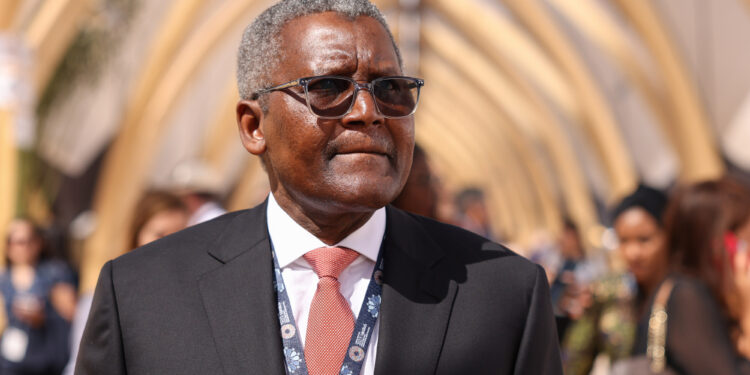
Aliko Dangote, Chairman of the Dangote Group, has announced that by next month, Nigeria will cease importing gasoline, thanks to the operational plans of the Dangote Refinery. Speaking at the Africa CEO Forum Annual Summit in Kigali, Dangote highlighted the refinery’s significant progress and its capacity to meet the diesel and petrol needs of West Africa and the aviation fuel requirements for the entire African continent.
Ending Gasoline Imports
Dangote emphasized the imminent end to Nigeria’s gasoline imports:
“Right now, Nigeria has no cause to import anything apart from gasoline, and by sometime in June, within the next four or five weeks, Nigeria shouldn’t import anything like gasoline; not one drop of a litre.”
Expansive Supply Capabilities
The refinery has already begun supplying diesel and aviation fuel within Nigeria. Aliko Dangote outlined the refinery’s extensive capabilities:
“We have enough gasoline to give to at least the entire West Africa, and diesel to give to West Africa and Central Africa. We have enough aviation fuel to give to the entire continent and also export some to Brazil and Mexico.”
Additionally, Dangote noted that the refinery produces polypropylene and polyethylene to meet Africa’s entire demand and is working on producing base oil and linear benzyl for detergents, aiming to reduce Africa’s dependence on imports.
Vision for a Self-Sufficient Africa
Dangote expressed confidence in achieving self-sufficiency in various sectors:
“As I said, give us three or a maximum of four years, and Africa will not, I repeat, not import any more fertiliser from anywhere. We will make Africa self-sufficient in potash, phosphate, and urea; we are at three million metric tonnes, and in the next twenty months, we will be at six million metric tonnes of urea, which is the entire capacity of Egypt. We are getting there.”
Investment in Africa
Reflecting on his long-term vision, Aliko Dangote recounted the decision to invest heavily in Africa rather than international markets:
“For some of us, despite the boom of the capital market in the US—you know, Google, Microsoft, and the rest—we didn’t participate; we took all our money and invested in Africa. We had this dream just about five years ago, and we said we wanted to move from five billion dollars in revenue to thirty billion dollars in revenue, and we made it happen. It is possible and now we have made it happen and now we have finished our refinery.”
Addressing Africa’s Import-Export Imbalance
Dangote stressed the need for Africa to produce finished products and create jobs rather than exporting raw materials:
“One of the things we also need to know as Africans is that we produce raw materials and export them when you export raw materials and somebody now keeps importing things into your continent and dumping goods. what you are importing is poverty and exporting jobs. So, we have to change that narrative.”
Future Expansion
The refinery, with a capacity of 650,000 barrels per day, is set to expand further:
“We just commissioned in February, and now we are producing jet fuel, diesel, and by next month, gasoline. What that would do is that we would be taking most of the African crude that is being produced and also be able to supply not only Nigeria because our capacity is too big for Nigeria, but it would also supply West Africa, Central Africa, and also South Africa. We have 650,000 barrels per day, 1 million metric tonnes of polypropylene, and 590,000 metric tonnes of carbon black; those are the raw materials—ink, dyes and co. We are expanding more. This is the first phase and we are going out to the next phase, which will start early next year.”
Aliko Dangote’s ambitious plans for the Dangote Refinery mark a significant step towards reducing Africa’s dependence on imports, fostering self-sufficiency, and creating a more robust economic landscape for the continent.