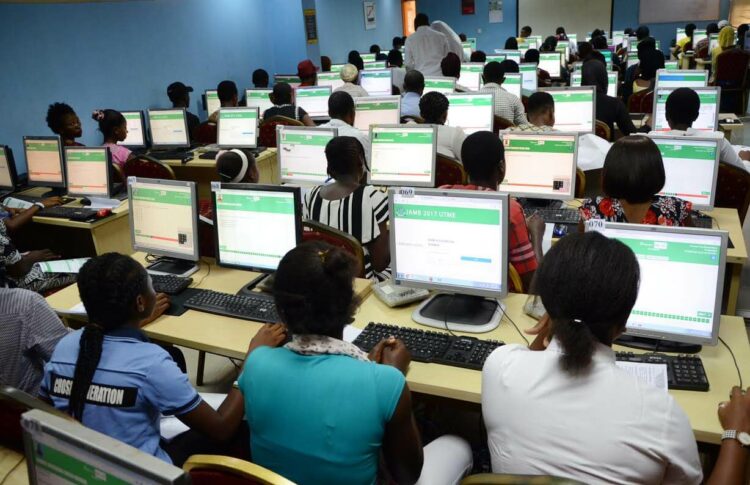
The Joint Admissions and Matriculation Board (JAMB) revealed that a father and his son were apprehended by the police for engaging in impersonation during the ongoing Unified Tertiary Matriculation Examinations (UTME). The JAMB Registrar, Prof. Ishaq Oloyede, disclosed this during his inspection tour of UTME centers in Kaduna. While the 2024 examinations were generally well-conducted, a few cases of impersonation were reported, which were made possible due to individuals possessing multiple National Identity Numbers (NINs).
Prof. Oloyede emphasized that those who cheat in the exams will face consequences, whether immediately or in the future. JAMB has implemented improved technological measures to detect and prevent various forms of examination malpractices. Impersonation has been a significant challenge across the country, especially with the introduction of NINs. Instances have arisen where individuals possess multiple NINs, undermining the purpose of identity verification. The JAMB Registrar expressed his intention to address this issue with the National Identity Management Commission (NIMC) to rectify the problem of individuals possessing multiple NINs.
One alarming case involved a father impersonating his own son and writing the examination on his behalf. Prof. Oloyede expressed his disbelief at the father’s actions, questioning how he could jeopardize his son’s future. Both the father and son are now in custody, although the specific state where the incident occurred was not disclosed.
Impersonation remains a prevalent issue, but JAMB is determined to stay ahead of those involved in such fraudulent activities. With the aid of advanced technology, JAMB is now able to identify and apprehend culprits more efficiently. Even those individuals who have been left under surveillance for research purposes will face consequences after the examinations.
During his visit to the Kaduna State University (KASU) CBT Centre, the JAMB Registrar took the opportunity to address candidates who missed the exams due to reasons unrelated to the examination body. He stated that JAMB cannot allocate substantial resources to organize another session for a few candidates who missed the exams due to their own negligence. It is crucial to note that the UTME is not a school-based examination, and JAMB cannot be held responsible for failures caused by candidates who registered through their secondary schools but failed to meet the necessary requirements, either intentionally or due to logistical challenges.
Prof. Oloyede highlighted a common scenario where students from hostels were made to register through their schools, primarily driven by the schools’ desire to collect additional fees from parents under the guise of JAMB registration. Consequently, these schools would cram up to 30 students into a single bus, dropping them off at different locations. By the time the last student arrived at their designated center, they were already late for the exam. The JAMB Registrar expressed his frustration with schools writing to him regarding such issues, emphasizing that he has no involvement with individual schools.
Furthermore, Prof. Oloyede shared an incident where a religious body requested that 100 candidates be assigned to a specific examination day, even going as far as dictating the school where the candidates should be posted. He questioned the legitimacy of such requests, reminding candidates that they have the right to communicate directly with JAMB. It is perplexing that candidates would submit their registration numbers to a third party who would then contact JAMB on their behalf.
Addressing the need for mega CBT (Computer-Based Test) centers, Prof. Oloyede mentioned that 1.94 million candidates were sitting for the 2024 UTME. He stressed the importance of support from highly populated states like Lagos in establishing mega CBT centers similar to the one in Kaduna, which can accommodate 4,000 candidates per day.
The JAMB Registrar expressed his belief that having two or three such CBT centers across the country would significantly alleviate challenges faced during the examination process. JAMB possesses the necessary resources to build these centers and only requires state governments to provide suitable land. While efforts have been made to persuade authorities in Lagos to allocate land for a mega CBT center, a satisfactory response has yet to be received. The success of the Kaduna center, which was made possible by the provision of land from the Kaduna State government and an investment of over N1.4 billion from public funds, serves as evidence of the positive impact such centers can have. The Kaduna center accommodates 1,100 candidates at a time, allowing for the examination of 8,000 candidates within two days. Prof. Oloyede remains optimistic that the authorities in Lagos will respond positively to JAMB’s request and provide suitable land for the construction of a mega CBT center.
As JAMB continues to enhance its examination processes and combat malpractice, it is crucial for all stakeholders to prioritize the integrity ofthe examinations. Candidates must adhere to the rules and regulations set by JAMB and refrain from engaging in any form of cheating or impersonation. The consequences of such actions not only affect the individuals involved but also undermine the credibility and fairness of the entire examination system.