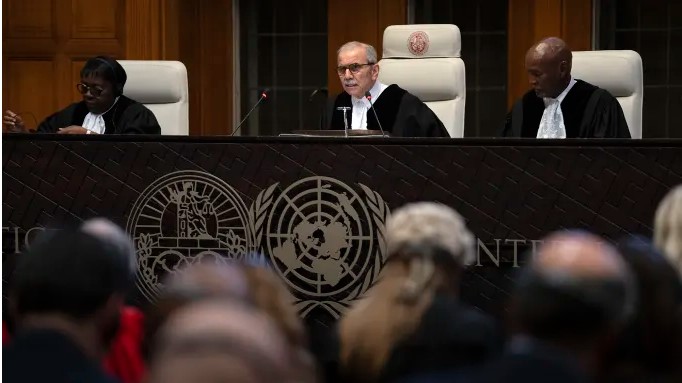
The United Nations’ top court, the International Court of Justice (ICJ), has ordered Israel to immediately halt its military operation in the southern Gaza city of Rafah. This ruling adds to the mounting international pressure on Israel regarding its ongoing conflict with the Hamas militant group.
The ICJ’s Ruling
Immediate Halt to Military Operations
On May 24, Judge Nawaf Salam, president of the International Court of Justice, announced the court’s decision, stating, “Israel must immediately halt its military offensive and any other action in Rafah which may inflict on the Palestinian group in Gaza conditions of life that could bring about its physical destruction in whole or in part.” The court’s ruling underscores the dire humanitarian situation in Rafah, which it classified as “disastrous.”
Humanitarian Concerns
The ICJ’s ruling also highlighted the critical humanitarian situation in Rafah. Before Israel’s offensive began on May 7, more than a million Palestinians were taking shelter in the city. However, the court noted that around 800,000 have since been displaced. The court ordered Israel to open the Rafah crossing for humanitarian assistance, emphasizing that the evacuation and living conditions provided by Israel are insufficient to alleviate the immense risk faced by the Palestinian population.
Reactions to the Ruling
Israeli Officials’ Response
Israeli officials have strongly condemned the ICJ’s ruling. Yair Lapid, leader of Israel’s opposition party Yesh Atid, criticized the court for not directly connecting the end of the military operation in Rafah to the release of hostages and Israel’s right to defend itself against terror. Naftali Bennett, former Prime Minister of Israel, expressed his disapproval on X (formerly known as Twitter), stating that the ICJ’s ruling provided terror organizations with a method to evade accountability.
Hamas’ Response
Hamas praised the ICJ’s ruling but expressed disappointment that it did not extend to the entire Gaza Strip. The militant group emphasized that the situations in Jabalya and other cities are equally dire and warrant similar attention.
International Reactions
South Africa played a pivotal role in bringing the case against Israel to the International Court of Justice. On May 10, Pretoria filed an urgent request for additional measures against Israel, accusing it of using forced evacuation orders in Rafah to endanger civilian life. This request was part of a larger case in which South Africa accused Israel of committing genocide against Palestinians during the seven-month-long conflict.
Broader Implications
Humanitarian Aid and the Rafah Crossing
The ICJ’s order for Israel to open the Rafah crossing for humanitarian assistance is a crucial aspect of the ruling. The crossing, which has remained shut since the Israeli military seized it, was a vital entry point for humanitarian aid. The court’s decision aims to ensure that essential supplies reach the affected population in Gaza.
Legal and Diplomatic Ramifications
Rulings by the International Court of Justice are final and binding, but the court lacks a mechanism to enforce them. Historically, such rulings have been ignored by the parties involved. The current situation raises questions about the efficacy of international legal institutions in resolving complex geopolitical conflicts.
The Role of the International Criminal Court (ICC)
The ruling by the International Court of Justice comes in the wake of actions by the International Criminal Court (ICC), a separate court in The Hague. The ICC’s prosecutor has sought arrest warrants for Hamas leaders, as well as Israeli Prime Minister Benjamin Netanyahu and Defense Minister Yoav Gallant, on charges of war crimes and crimes against humanity. These developments indicate a growing international focus on accountability for actions taken during the conflict.
Conclusion
The ICJ’s ruling to halt Israel’s military operation in Rafah marks a significant moment in the ongoing conflict between Israel and Hamas. While the ruling aims to address the dire humanitarian situation in Gaza, its implementation remains uncertain due to the lack of enforcement mechanisms. The reactions from various stakeholders highlight the complexity and contentious nature of the conflict. As the situation continues to evolve, the international community will be closely watching how both Israel and Hamas respond to the court’s decision.