Recent reports from BBC News, reveal that an Israeli missile struck Iran in what is widely regarded as a retaliatory response to Iran’s missile and drone attack on Israel. This exchange of attacks marks a significant escalation in the ongoing conflict between the two nations.
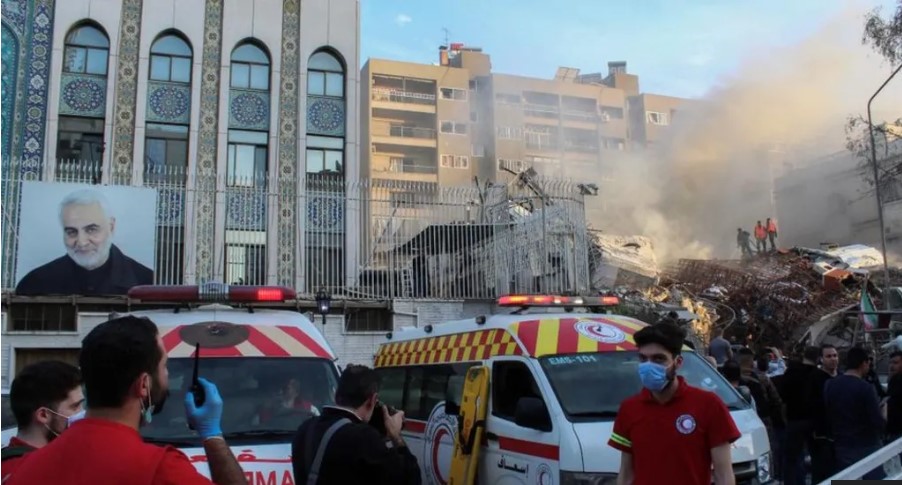
The initial attack by Iran on Israel, its first ever, was purportedly in retaliation for an Israeli strike on the Iranian consulate in Damascus, Syria. This strike resulted in the death of senior military commanders, further fueling the animosity between the two countries.
Israel and Iran have been engaged in a shadow war for years, with both sides carrying out covert attacks on each other’s assets without formally acknowledging responsibility. However, the intensity of these attacks has significantly increased during the current war in Gaza, which was triggered by an assault launched by the Palestinian group Hamas on Israeli communities in October.
The history of enmity between Israel and Iran dates back to the 1979 Islamic revolution in Iran. The revolution brought about a regime that considers opposition to Israel as a fundamental aspect of its ideology. Iran does not recognize Israel’s right to exist and actively seeks its eradication. Ayatollah Ali Khamenei, the country’s supreme leader, has gone as far as describing Israel as a “cancerous tumor” that will eventually be uprooted and destroyed.
Israel, on the other hand, perceives Iran as an existential threat due to its hostile rhetoric, support for proxy forces such as the Lebanese Shia militant group Hezbollah, and its alleged funding and arming of Palestinian groups like Hamas. Additionally, Israel accuses Iran of covertly pursuing the development of nuclear weapons, a claim Iran vehemently denies.
The attack on the Iranian consulate in Syria followed a pattern of airstrikes on Iranian targets, often attributed to Israel. These strikes have resulted in the deaths of several high-ranking Iranian Revolutionary Guard Corps (IRGC) commanders. The IRGC plays a crucial role in facilitating the transfer of arms and equipment, including precision missiles, to Hezbollah through Syria. Israel’s objective is to prevent these deliveries and hinder Iran’s military presence in Syria.
Iran’s subsequent drone and missile attack on Israel was a significant escalation of hostilities. The attack reportedly involved over 300 drones and missiles, including ballistic missiles and cruise missiles. Israel’s defense systems managed to intercept the majority of the incoming barrage, but US officials informed CBS News that five ballistic missiles did impact Israeli territory, with four targeting the Nevatim air base in the Negev desert.
In response to these recent events, US officials have confirmed that Israel conducted a strike on Iran. The details regarding the type of weapons used and the launch location remain unclear. Iran’s Fars news agency reported explosions near an army base, with air defense systems being activated. However, Iran’s National Centre of Cyberspace spokesperson dismissed claims of an external air attack, stating that Israel’s attempt to deploy drones had been unsuccessful and resulted in their downing.
The province of Isfahan, located in central Iran, was the reported target of the Israeli attack. This area houses significant Iranian military infrastructure, including an airbase, missile production complex, and nuclear facilities.
In terms of military capabilities, Iran has invested heavily in missiles and drones. While it possesses a vast arsenal, it has also supplied significant quantities of weapons to proxy forces such as the Houthis in Yemen and Hezbollah in Lebanon. On the other hand, Israel boasts one of the most advanced air forces globally, with a range of sophisticated jets at its disposal, including the F-35 stealth aircraft.
Regarding nuclear weapons, Israel is widely assumed to possess its own, although it maintains an official policy of deliberate ambiguity. Iran, on the other hand, denies having nuclear weapons and insists that its civilian nuclear program is not aimed at acquiring them. However, international scrutiny has arisen due to the discovery of uranium particles enriched to nearly weapons-grade levels at Iran’s underground Fordo site.
Iran has strategically built a network of allies and proxy forces across the Middle East, forming what it terms an “axis of resistance” against US and Israeli interests in the region. These allies include Syria, Russia, Hezbollah in Lebanon, Shia militias in Iraq, and the Houthi movement in Yemen. The support provided by Iran to these groups varies in degree but has contributed to regional tensions.
As the conflict between Israel and Iran intensifies, the ramifications extend beyond their borders. The situation remains volatile, with the potential for further escalation and increased regional instability. The international community will closely monitor developments, hoping for a de-escalation of hostilities and a peaceful resolution to the long-standing disputes between these two nations.